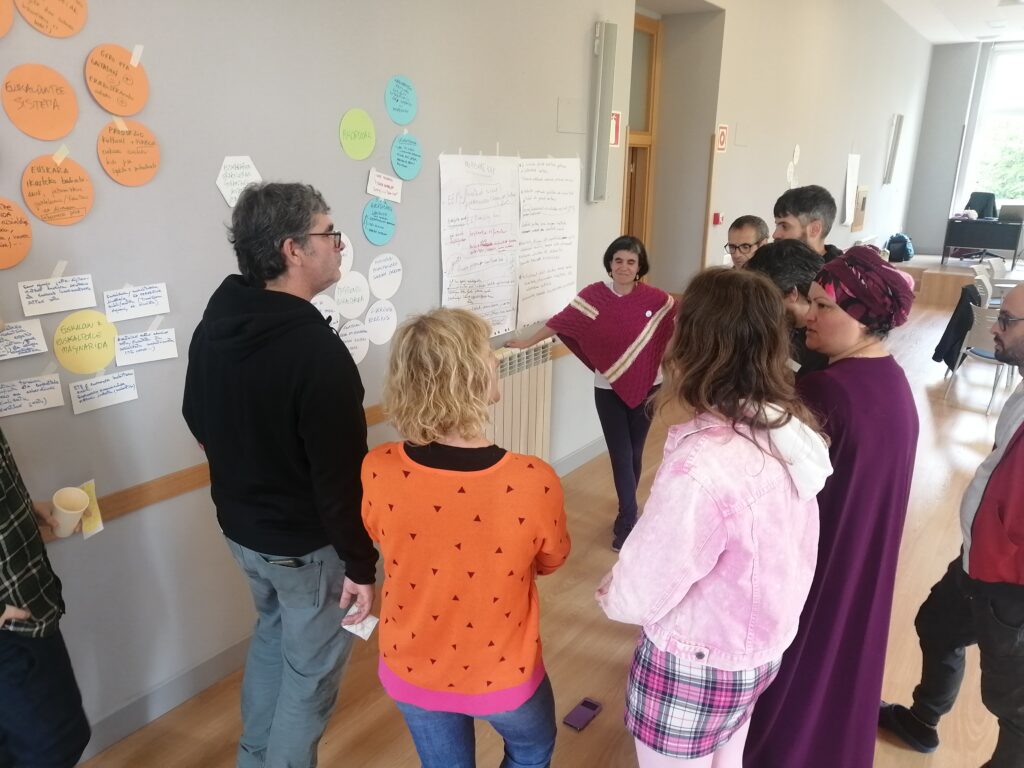
For the revitalization of Basque to move forward, it is essential to periodically update discourses. This was the starting point of Taupa’s work in 2023 within the social laboratory Batera Jauzi: ensuring that strategies and discourses in favor of Basque are able to connect with today’s diverse society.
The first major lesson was the need to broaden perspectives. Beyond traditional Basque language activism, an enriching dialogue process was developed with a wide range of actors: young people, feminist movements, migrants, socio-economic stakeholders, non-Basque speakers, and others. The goal was not only to strengthen the discourse in favor of Basque, but to connect it with the concerns and struggles of society as a whole. This process revealed that the future of the language does not belong only to its speakers, but to the entire community. Consequently, discourses must also be capable of addressing the whole community.
In addition, deeper innovations emerged in the discourse. On the one hand, the concept of “language wounds” gained strength: it was understood that it is essential to acknowledge the collective wounds experienced around minority languages—shame, exclusion, the pain of loss—in order to build future-oriented discourses. On the other hand, the recognition of the “imperfect speaker” became central. Rigid views on speaker models have often excluded many people; instead, revitalization highlighted the need to embrace diversity and different linguistic trajectories, and to foster more relationships between different people.
Finally, the systemic perspective brought the most significant innovation. Language is not only a matter of use or motivation, but the result of an entire ecosystem: a space where social, economic, cultural, and political conditions intersect. This perspective shifts the discourse from the individual to the collective, and also distributes responsibility.
From the Batera Jauzi experience, we have learned that renewing discourse is not a purely theoretical or academic exercise, but a process that begins with listening to the community, acknowledging wounds, and collectively imagining the future.
To achieve this, it is necessary to develop many more relationships beyond traditional language activism, building much stronger networks in our towns and neighborhoods, among diverse communities, with those who need or are in the process of approaching Basque. Adapting discourses to support these pathways will become increasingly important, and for this we need tools that empower Basque supporters and provide them with resources to shape discourse. We face a dual task: on the one hand, developing cohesive discourses that are motivating for Basque supporters; on the other, creating adapted relationships and discourses with non-Basque speakers or those at different stages of language acquisition. Both are needed.
And that is precisely where the next leap in the revitalization of Basque lies.