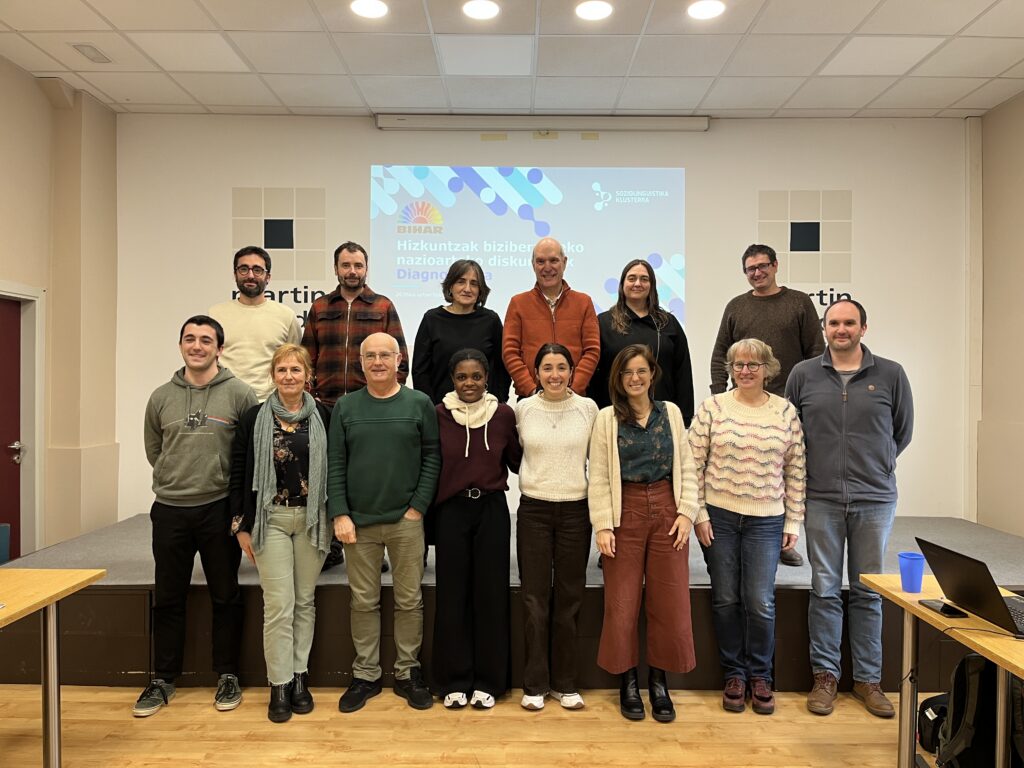
In 2025, the discourses of communities around the world working on the revitalization of minoritised languages were gathered. Specifically, the narrative elements of 70 language communities were analyzed, with intersectionality as the central framework. The result of this work is a diagnosis that identifies international discourses on language revitalization, based on a broad perspective of linguistic diversity and the needs of communities.
Within this first axis, led by the Sociolinguistics Cluster, collaboration with various organizations has been essential in completing the diagnosis: the First People’s Cultural Council (FPCC), the Endangered Languages Project (ELP), LINGUAPAX, la Cátedra UNESCO del Patrimonio Lingüístico Mundial de la Universidad del País Vasco (EHU), and and the gathering of young speakers of minoritised languages (HIGA), the meeting of young speakers of minoritised languages.
Following the internal presentation of the diagnosis to the BIHAR project team, the organizing group of BIHAR has moved—at the beginning of the new year—from the international diagnosis phase to a process of socialization to be carried out in the Basque Country.
Thus, under the guidance of members of Taupa Mugimendua, in the spring of 2026 the results of the diagnosis will be shared with the Basque language community and with actors from other social movements across the Basque Country. In total, twenty working sessions have been organized throughout the territory, with the participation of more than 100 stakeholders expected. These participants will come from diverse social fields: Basque language activism, feminism, environmentalism, youth movements, migrant solidarity collectives, the LGTBIQ+ movement, anti-racism, and international cooperation, among others. To conclude these working sessions, a joint seminar will be held.
The main challenge of this process is to connect language revitalization processes with other social demands, in order to broaden the perspective of communities’ needs and interests.